Loading...
Skip to main content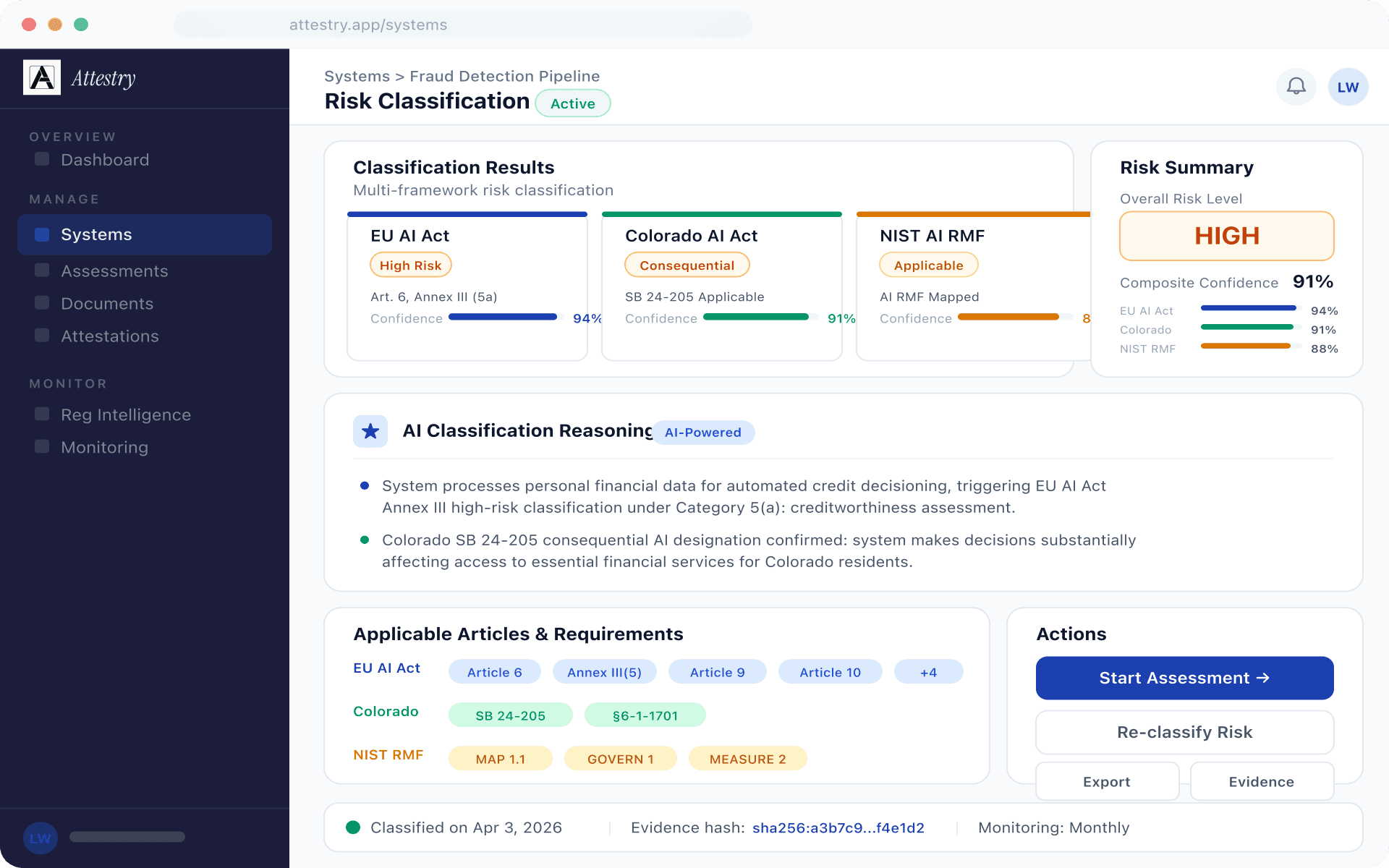
Capability · risk classification
AI-powered risk classification
Multi-framework risk tiers with the article references your auditors will demand.
Risk classification is the hinge of every AI compliance regime, and every framework defines risk differently. The EU AI Act has four tiers tied to specific use cases. Colorado defines 'consequential' AI by impact on protected attributes. NIST AI RMF applies Govern, Map, Measure, and Manage as cross-cutting functions to every system. Attestry's classifier evaluates your system against all three, cites the article or clause that triggered each conclusion, and returns a calibrated confidence score on the EU AI Act tier so your legal team can defend the classification, not just trust it.
What's included
Built to be auditor-ready out of the box
EU AI Act 4-tier classification
Unacceptable, high-risk, limited-risk, minimal-risk, with Article 5 prohibitions, Annex III high-risk use cases, and Article 50 transparency obligations cited per system. Prohibitions surface before the classification is final.
Colorado AI Act consequential determination
Identifies systems making consequential decisions under Colorado's framework. Deployer and developer duties are broken out separately so each role's obligations are explicit.
NIST AI RMF applicability
Maps each system to the four NIST functions (Govern, Map, Measure, Manage), with applicability surfaced as a flag per function. Subcategory-level gaps surface during the NIST AI RMF assessment workflow.
Reasoning trace with regulatory citations
Each conclusion expands into a reasoning trace citing the article or clause that triggered it: Annex III categories, Article 5 prohibitions, deployer/developer duty mapping. A confidence score on the EU AI Act tier shows where manual review is highest value.
Powered by
Cryptographic primitives behind this capability
Each capability rests on signed, verifiable signature components.
Start attesting in 60 seconds.
Free plan includes fingerprinting, unverified attestations, and a public registry listing. Upgrade when you need signed proofs or SLA-backed verification.