Loading...
Skip to main content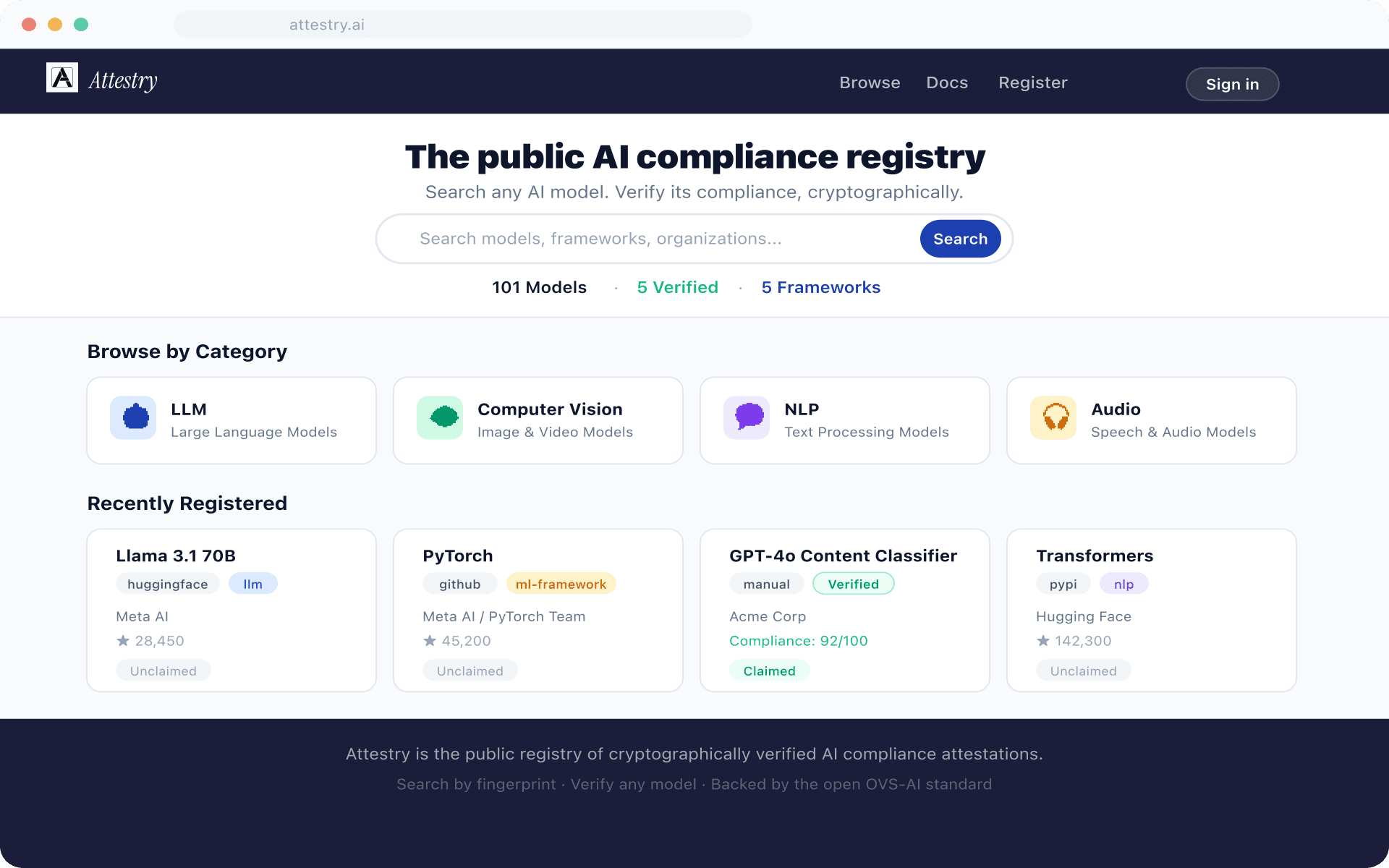
Capability · model registry
AI model registry
The public record of AI compliance: searchable, verifiable, and free to register.
Attestry's public registry is where AI models get listed, claimed, and attested against the open OVS-AI 1.0 specification. The registry is indexed from public APIs at HuggingFace, GitHub, npm, and PyPI, so any developer's work is discoverable from the moment it ships, and creators can register their own work directly via the free registration API. Each entry has a stable slug, an SVG status badge, a regulatory-impact PDF mapping it to EU AI Act, NIST AI RMF, ISO/IEC 42001, and Colorado, plus a public watchlist anyone can subscribe to for status, score, expiry, and regulatory-impact notifications. Verified attestations appear on a leaderboard ordered by overall compliance score.
What's included
Built to be auditor-ready out of the box
Indexed from major AI ecosystems
Models are indexed from public APIs at HuggingFace, GitHub, npm, and PyPI on a daily rotation, so the registry stays current with new releases. Indexing identifies itself with a transparent User-Agent and respects each platform's published rate limits and terms of service.
Free registration, claim, or takedown, all email-verified
Anyone can register a model via the free registration API; a claim token is mailed to the verified email so the entry can be linked to a registered AI system. Creators who'd rather not be listed can submit a takedown via the same verified-email mechanism. For npm packages, takedowns are auto-approved when the requester's verified email matches the maintainer email on file (npm enforces maintainer-email verification at publish time). PyPI, HuggingFace, GitHub, and manually-added entries route to admin review.
OVS-AI 1.0 specification + regulatory-mapping PDF
The Open Verification Specification for AI Compliance is published as a downloadable PDF spec. Each registry entry generates a regulatory-mapping PDF that translates OVS-AI clauses into EU AI Act, NIST AI RMF, ISO/IEC 42001, and Colorado AI Act requirements.
SVG badges, watchlists, webhooks
Every entry has a /api/v1/registry/badge/[slug] SVG endpoint for embedding. Public watchlists subscribe by email to status changes, score changes, attestation expiry, and regulatory-impact events; a webhooks endpoint mirrors the same events to downstream systems.
Powered by
Cryptographic primitives behind this capability
Each capability rests on signed, verifiable signature components.
Start attesting in 60 seconds.
Free plan includes fingerprinting, unverified attestations, and a public registry listing. Upgrade when you need signed proofs or SLA-backed verification.